
the oppressor in us.
On the Nigerian Syndrome.

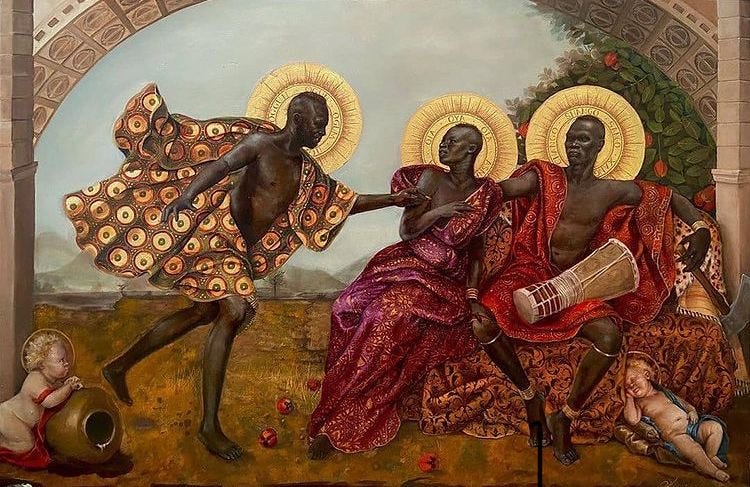
I always have this hypothesis whenever I’m out, looking at distressed Nigerians with their faces etched with worry; hustling for money to afford the next meal as a result of the current political climate—that if we are to take, let’s say, twenty of these Nigerians, and somehow catapult them into various political seats of power where they could make a change, would they possibly, as a result of their suffering, turn this country into something brand new?
Of course not, as they would know little to nothing about the inner workings of running a country or may not even be educated on how politics work. Let’s run another hypothesis and say that all these boxes are checked, would they then, driven by the experiences they faced living in a country where the minimum wage isn’t even enough to afford a bag of rice—make a difference?
Of course not because too often Nigerians overlook an oppressive system but are rather paving ways for themselves to be the oppressor.
This phenomenon can be described as internalized oppression or the Nigerian syndrome as Dele Farotimi observes. Having its roots from colonial rule and still making its way towards our society today, this “syndrome” is a state in which Nigerians do not view the sufferings from the government as something they should attack, but rather find means and search for ways either big or small for them to also be in a position of power and indulge in exploitative means. It is also a pattern in which we can now observe where most Nigerians—not even the one in government positions but the oppressed class—silence and shut down people who speak about the ills of the current administration.
This, of course, does not apply to everyone, but is however an observation of our current society due to the way things are currently being played out. When we think of corruption and bribery, we think of the few upper echelons who use government budgets directed at public funding and shift it into their pockets. But this corruption we so despise does not only exist within the political factor; it is the policeman who collects a couple thousand naira on the highway, it is the racketeering of admission by school bodies, it is the illegal taxes collected from bus drivers, it is the workers who make sure they get their share in the contract, it is the pastor collecting all sort of donations from people for themselves in the name of “offering”. It is everywhere. We are quick to point fingers at the government but lack that sense of reflection on the fact that those in power are just a mirror on the ideals and values of the people. It is the failure of asking yourself the simple question, what would I do differently if I were to be in that position?
As Leonard Karshima writes; “What Nigerians blame in their “leaders” is a thriving virus within themselves!”
Too many a time whenever I tell my friends that I might get into politics someday, their response is often stilted on the fact that I’m going to end up making a lot of money. As a result, they see politics as a business advent, rather than a means of service to the people.
It’s hard to draw a fine line on the ideal problem of our country because there is too many. However, for the purpose of this essay, I’ll be focusing more on the political aspects. We live in a country where a senator earns a gross amount of one million naira with some reports saying up to twenty-one million, according to BudgetIT, including a number of allowances. Some even complain that it not enough . Mind you, majority of the citizens live below the poverty line. Where budget after budget is allocated to create structural and economic reforms but the road in my street is still inflicted with potholes and floods terrorize my neighborhood.
Nigerians do see a problem with this, not a day goes by where we don’t curse at the fallacy of our government only to try and be content with the fact that things keep on getting harder and harder as the day runs by. Where the hypocrisy comes in, is that Nigerian will latch on any singular opportunity to be a part of that systemic group of individuals who cause the issues we face.
There is quite a lot of reasons for this paradox, one laying with the idea that Nigerians have this poverty mentality—given, since the country is currently in a state of economic regression. However, they’d rather strive towards putting themselves in positions where the same can be done to others. “This life na turn by turn” claims the popular Nigerian phrase. Nigerians are simply waiting for their turn; not a turn to make changes but continue this cycle of oppression which ironically, they’ve once endured. As Fredrick Nwabufo writes in Hypocrisy of the Oppressed in Nigeria, “while the oppressors steal from the oppressed, the oppressed steal from the oppressed.” Our main focus isn’t targeting the set of individuals who are using our tax money to buy private jets, spend on healthcare abroad and send their children to the most expensive schools, it’s finding ways though whatever power we might have to control people, and put money in our pockets as well.
Our culture has also helped justify how Nigeria “oppress the oppressed”. In this country, respect is revered to which I can even be called names for not greeting that old lady on the street. This is not necessarily a bad thing but there is this sense of entitlement that comes with, which can be observed in the way they treat children, women or people in lower job positions or economic status. Someone on Reddit writes, “Nigerians have an authoritative issue…this leads for actually authority to be corrupt because they know Nigerians won’t question them.” This oppressive traits we see in our government is still enforced in that Nigerian who might just be a couple years older than you or be blessed with wealth. Instead of using whatever medium you have to help people, the average Nigerian would rather use this to their advantage to ridicule people so as to gain wealth.
I think the most frustrating part about this whole issue is that a particular set of Nigerians are quick to silence people who speak up about the sufferings the citizens are currently experiencing. Not the government, or public servants but by struggling Nigerians themselves. Like how much more conflicted can a country of people be?
This brings me back to Raye, an NYSC corper who took to the internet to express her constitutional right by critiquing the government. However, what we see is not solidarity on the very pressing issues to which she addressed, but means to silence her, insults on her person and ridicule by Nigerians, who probably do not have the menas necessary to acquire breakfast the next morning.
I will acknowledge that there’s been this “fatigue” in Nigerians when it comes to calling out the government as a result of the 2020 #EndSARS aftermath. Yet, attacking people and asking “Why would they speak up?” towards an evident problem in the country is just part of the hypocritical nature of these Nigerians. Enabling the practices of these people in power. The kidnapped defending the kidnapper.
I don’t think Nigerians are ready for change. We speak and want this revolution to happen and yet, we are still the enablers of it. Nigerians do not want the system to change; they want it to benefit them. This is not because we’re inherently evil people, but because we’ve been taught that respecting the toxic parts of our culture, using whatever means to uplift ourselves from poverty, and fearing those in power, is the only way we know to survive a country saddled with poverty.
The thing that we fail to understand is that change comes from the mind. Not by cursing and nagging our teeth at these individuals who, in the end will get away with it. This problem we see doesn’t sprout from nowhere; it is something ingrained in us. So, as a result, this nation might not see the revolution we all strive for, if we fail to break down and unlearn these dangerous ideals that has become a part of us.
I think the problem started from the beginning of Nigeria. The corruption was bad at top levels so it destroyed and citizens had to look for a way to adapt, by extortion, bribery and further corruption. It became a way of doing things a culture. A culture of silence, eye-service, hypocrisy and sucking up. So now, we don't see it as evil, we see it as normal, wisdom, necessary even. We rationalize; at least what we are doing pales in comparison to what is going on in higher levels, it makes us feel like saints when we are anything but.
Then again any hope of reformation is efficiently snuffed out because no good deed goes unpunished. Every protest, honesty, integrity, activism, it's dangerous. Whether you embrace poverty or some form of torture, it never seems to yield good results. We are short-sighted and selfish. We don't believe in patriotism or working for our country because the country never ever worked for us. It deducts our wages for being good and it threatens to sack us.
Religiosity doesn't help much too. It gives us leave to fold out hands and wait for the divine to mete out justice on what we perceive as evil. In the popular sayings we have it's easy to read our mentality. Scratch my back I scratch yours; when I was poor you didn't ask for the source of my poverty but you want to know the source of my wealth. We hold money in high esteem because it's everything we need but don't have; healthcare, good education, security, food, choice. Can you blame the underpaid, underarmed policeman who only joined the force because he couldn't afford a good uni education? He is just as much a victim of Nigeria as the criminal/driver he's extorting. They all found a shortcut to get food to their mouths.
The problem is like a very long rope with intertwined knots you hardly know what end to lose from.
I know this comment is long. I didn't intend for it to be this long, I got carried away, there's just a lot to say frfr🥲
Nigerians don't actually even care about whether the country is good or not. We just desire a seat at the table. Like you said, many Nigerians will attack governments now but when they have an ear of one local government chairman? forget it. they become worse than the politicians they hated.
it's a vicious cycle. only God can help us at this rate.
This was a beautiful read Oreva.