
is valentine’s day capitalist propaganda?
a history of valentine’s day, it’s highjack by companies and the distortion of love under capitalism.

This essay is four days too late, and I had debated publishing it next year but I have thoughts and they are in desperate need to be expressed.
Everyone and their mothers and dogs named Johnny won’t shut about it (I sound bitter, I know); expectant of the presents, the show of affection, the chocolate the letters and the roses—a spectacle tagged Valentine’s day.
Now, I personally didn’t get anything, not that I mind, but there were some wishes by my beautiful friends, reminding me that it’s doesn’t always have to be about boyfriends or girlfriends, it’s about loving those who cherish you too.
However, there are people who hold the notion that the holiday is nothing more than capitalist propaganda and given its history and outlook by society , it is quite alright to believe it as so. They argue that Valentine’s day has become nothing more than a consumerist celebration that has distorted love from feelings of affection and want, to something tied to price-tags.
Others argue that it is not a consumerist holiday for if so, isn’t that the same for everything else? Shopping? Consumerist. Buying groceries? Consumerist. Stocking up on makeup? Consumerist. So that should not be stilted to just one holiday.
To answer that question, here are my thoughts.
History

To begin, Valentine’s day was a Catholic holiday in the 5th century created by Pope Gelasius to honor the death of St. Valentine’s, who is described as a “patron saint of lovers, beekeepers and epileptics.”1The real story of who St. Valentine is has been mystified and is completely vague as we don’t know if he was one person, or two. Additionally, his identity as a patron saint of lovers, is quite unknown.
The honor of name becoming a day of celebration was done to replace the Roman pagan holiday and tradition of Lapercalia that was celebrated along February 10-15th and contained practices that the Pope wasn’t too happy about. As a result the Catholic Church declared February 14th as the day of honoring the death of St. Valentines and since then singles have not known peace.
It’s transition from a Catholic holiday to love
There was nothing romantic during this period but early traces recognize the English poet Geoffrey Chaucer that assigned valentine’s day to love in his poem “Parliament of Fowls”. He talked about Valentine’s day as the start of the bird mating season, thus seeing the day as one of love.
This then was picked up and explored by many other writers and poets of the 15th century, most famously known is Willam Shakespeare’s Hamlet:
Tomorrow is Saint Valentine’s day,
All in the morning bedtime,
And I a maid at your window,
To be your Valentine. -Ophelia
In 1784, a poem in Gammer’s Gutron goes along the lines of;
“The rose is red, the violet’s blue,
The honey’s sweet, and so are you.
Thou art my love and I am thine;
I drew thee to my Valentine:
The lot was cast and then I drew,
And Fortune said it shou’d be you.”
I think we are all very familiar with that.
As a result this opened the world to see Valentine’s day as one of love and affection.
The shift to consumerism
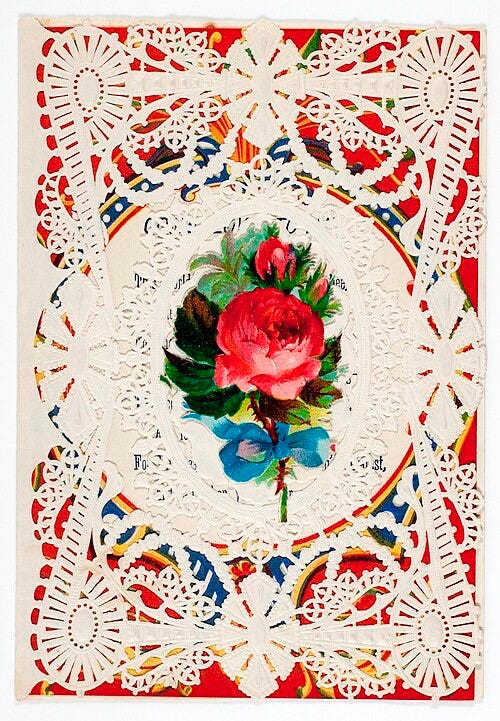
In the 1400’s, friends and couples in Europe were exchanging hand written poems; which become a catalyst for todays gift cards. Esther Howland of Massachusetts imported these hand crafted gift cards from the UK into America and began to a business with it.
From then on, companies steadily began to commercialize the holiday, with notable names like Cadbury, Hershey, Coca-Cola and DeBreers a famed diamond company also launched its “a diamond is forever” campaign in 1948 to connect quality jewelry with an expression of love.
These produced anything and everything from heart-shaped chocolates to cakes, pajamas, sexy night clothes, sweets, drinks, etc, all as an easy cash grab for the holiday and marketed as the celebration of love. In modern times, stores are filled with red and white themed items while companies create ads and offers pushed at the holiday, passing the message that to love someone is to spend a generous amount of money on them; not really for the sake of your lover, but that of the capitalist.
Although it is worth mentioning that it wasn’t capitalism that started the celebration and commercialization of Valentine’s day—it had existed centuries before, however it had helped push and market it into the hyper-consumerist celebration that it is today.
Even at that time, there was pushback to the holiday’s rapid commercialization. Similar to anti-Valentine’s Day arguments today, many people thought that the push to buy mass-produced gifts in honor of love defeated the holiday’s overall purpose of creativity and celebrating love on an individual scale.
Capitalism and love.
The celebration of love has now become influenced by class and social standing. We are all familiar with the phrase; “if you don’t have money, don’t fall in love,” and while that sounds just given the arrangement of our current society—one thing we fail to ask is why? Are poor people undeserving of love? Knowing how institutional and intentional poverty is in the hands of the ruling class, that statement kind of falls apart and blames individuals for their poverty. It further wants to take away the single most beautiful thing the world has let us experience from lower and middle class people.
In my essay, “the transactional nature of Nigerian love.” I had underlay how most of relationships (in Nigeria but I think that can also be expressed in other societies) has come to be understood by material possessions and gain, rather than need or emotional connections. It becomes a transactional means to an end and these are expressed through constant gift giving and displays of wealth; which have shifted to the point of entering relationships. Attraction is existent, but material (and sexual) gain seem to be the most glaring factor observed by the partakers of the relationship as well society.
Also, through hustle and grind culture as well as the usual “9-5” promoted by capitalism, it has led to the lack of the full exploitation of romance and love in all its forms. Bell Hooks writes:
“many jobs undermine self-love because they require that workers constantly prove their worth. Individuals who are dissatisfied and miserable on the job bring this negative energy home. Clearly, much of the violence in domestic life, both physical and verbal abuse, is linked to job misery. We can encourage friends and loved ones to move toward greater self-love by supporting them in any effort to leave work that assaults their well-being.”
Love under capitalism is nothing more than a class-based performance where companies convince you that funding them is the great way of portraying love to your friend or partner. And whilst it can be expressed in other non-material forms—said forms are not appreciated and seen as “unromantic” by society and maybe even the receiver themselves.
To answer the question; is valentine’s day capitalist propaganda?
I’d say yes— and no.
Capitalism was never the hallmark of the day being a celebration of love as that had come way before its inception. However, it has had great influence on its commercialization in modern times and how society has come to view relationships; influencing human behavior towards the holiday.
In the same vein, that can be equally said for other holidays, Christmas, New Year, Easter, etc in which stores are crowded with items to be bought and used to celebrate. Additionally, there is really nothing wrong with giving these monetary and material gifts as they can also be heartfelt and genuine ways of showing appreciation and gratitude to a lover. The problem comes with society equating cost with depth.
There is no one way answer; however I would conclude this by saying we as a society need to stop seeing love through the lens of money as we oftentimes do. It is so much more. It is raw, powerful, beautiful and deeply unapologetically human, something that should not be measured by how much we spend.